Showing posts with label Nuclear. Show all posts

Wednesday, February 8, 2012

The Solution to Pollution is Dillution

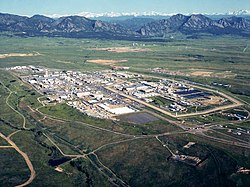
Rocky Flats (Wikipedia)
Rocky Flats was a nuclear weapons production site (hydrogen bomb and plutonium) until 1992.  As with most of the national lab associated with the weapons program  they had leakage of radioactive material into the environment.  (Is there a weapon's lab that didn't have a release?)  One such release exceeded the EPA's limits for soil contamination by a little bit, so the Rocky Flat's solution was just to till the group; dilute the contamination to below the EPA limits.  This didn't fly, and eventually Rocky Flats had to clean up their mess.

This brings up an interesting point; why was it a problem to dilute the pollution to below the EPA limit?  Almost all of the NRC operating limits are not determined by the amount of radioactivity you release, but rather how much you release per volume / mass or the dose, which depends on the per volume / mass you are in contact with (for the exact values, see 10 CFR - there is some good stuff in there).   Their probably shouldn't be so much leeway in the codes - a hard amount of radioactivity released (in activity, broken down by isotope) should be set.

How many messes do you clean up by diluting?

Wednesday, November 16, 2011

100 uCi Co60 Source

A while ago I talked about the design of a 100 uCi Co60 source holder.  Budget constraints happened, so the eventual design was just to throw a bunch of lead bricks around it with some HDPE on top.  The white on top is the 4" high of HDPE (plastic - check out the milling detail around the center pipe), while below it to the gray base are 4 4"x8"x2" lead bricks and 4 4"x4"x2" lead bricks (about 150 lbs of lead total).

The lid is solid steel, as is the source holder on the front left corner (I got to use a milling machine! - there pretty nifty, POLK needs one).  The interior pipe is 1/4" thick steel as well.

The best though, is my awesome paint job.

We should get the source for it before Christmas.

Tuesday, September 27, 2011

Neural Network Representation of Cross Sections

I learned about radial basis neural networks which utilize an activation function, and since the activation function are mostly Gaussian I wanted to see if they could be applied to the simulation of cross section data.  (Resonance structures in most cross sections are modeled with the Briet-Wigner formula, which is essentially a modified Gaussian).  I asked to do it in place of my homework, but wasn't allowed.

Neural Network Cross Sections

Cross section data from http://www.nndc.bnl.gov/sigma/index.jsp, U238 total. Can download a text file, and than just import it in. First column is energy (eV), second is cross section (b).
load('CrossSectionData.mat');

Creating the network

net = newrb(data(:,1),data(:,2));
% Viewing the created network
net.view
NEWRB, neurons = 0, MSE = 0
Sorry this is transparent

Looking at the performance

loglog(data(:,1),data(:,2));
hold all;
loglog(data(:,1),sim(net,data(:,1)));
hold off;
legend('ENDF','Neural Network');
title('(n,total) of U^{238}');
xlabel('Energy (eV)');
ylabel('Cross Section (b)');
ENDF data not visible because the neural network lies over top


Looking at the error

figure;
loglog(data(:,1),abs(data(:,2)-sim(net,data(:,1))));
title('Error of Simulated Network');
xlabel('Energy (eV)');
ylabel('abs(\sigma_{NNDC} - \sigma_{net}');
% No Error - Might be bad at extrapolation
sum(abs(data(:,2)-sim(net,data(:,1))))
ans =

     0

Zero error, so plot is empty on a log scale (can't take logarithm of zero)

There are games that could be played.  The number of neurons could be reduced, and the activation functions could be changed to resemble more of the form of the Briet-Wigner. 
Tuesday, September 20, 2011

Nuclear Security Challenges

I recently attended two talks by Ambassador Linton Brooks (START Treaties (Strategic Arms Reduction Treaties)) in which he talked about nuclear security challenges.  I few of the more intresting items I learned.
  • One of the largest problems facing America is orphan sources.  I thought these were mostly small things, (a few curies), but evidently they are large - and most come from Radiosotope Thermal Generators that were used to power lighthouses along the Soviet coastline.  I think the idea behind RTG's are nifty - they are used to power deep space craft - but the dose rate / chance for proliferation makes them sort of impratical.  For example, Sr90 (used by the Russian RTG's) has a beta decay of 0.546 MeV to Y90, which then has a beta decay of 2.28 MeV to Zr90, which is stable. The half life of Sr90 is about 20 years, and the half life of Y90 is days, so we can assume that all we are essentially getting 2.82 MeV per decay.  In order to get 1 Watt we would then need 2.74E12 decays/s or 74 Ci, and this doesn't account for any efficiencies.
  • A majority of Russians still consider the US a threat, while the US no longer considers Russia to be a nuclear threat.  I thought both nations no longer considered each other to be threats.
  • The reduction treaties only count strategic weapons, not tactical ones.  Counting tactical weapons is a lot more sensitive.
  • There was a dirty bomb incident in Russia.  The device never went off.  
  • Perhaps the largest threat for the US is preventing a conflict escalation between Pakistan and India.
  • Nobody knows how to deal with North Korea, a "Jerkwater State"

Wednesday, August 31, 2011

DHS Criteria

We almost have a detector that passes three of the four DHS criteria!  And, it would only have to be about 50 cm by 50 cm - some of the other preliminary designs from other universities called for multiple meter sized devices.


Thursday, August 18, 2011

Ballin'

Today I got SCALE and NESTLE!  SCALE is a reactor analysis code the couples nicely with MCNP (use MCNP to solve the flux, and SCALE to handle the decays) so I can finally start to work on the fuel cycle for Blue Box.  Think of this as Rocky Road ice cream.

I also gave one of my better presentation, and found a pretty clever way to calculate the Department of Homeland Security criteria for our detector setup.  How about a little caramel sauce?

To top it off, my nuclear security class is doing a mock simulation for the end of the year project at Y12.  I have seen the board at Y12 (it is similar to the things you see in war movies, except with fake buildings and toy soldiers to simulate hostile takeover of nuclear sites), and it is pretty awesome.  Y12 actually teaches other countries how to protect their nuclear sites, so it should be a good learning experience.  SPRINKLES!

AND TVA is continuing the construction of Bellefonte.  CHERRY!